Christmas Eve: The interconnected web of life by Kevin Watson

In this, the final blog of this series I want to give thanks for the community that makes an experiment like this worth doing. We have had a good range of perspectives and tones as we have considered  the blessings of a wide range of things from indoor plumbing to the friendships that change us. So first of all thank you to everyone who has written pieces.

I also want to thank all the people who have read these posts each day and those who have been in touch to comment on it. My starting point for this final blog came from this comment by Isabel Pebody:

It struck me recently what a blessing it is to be able to enjoy someone else being happy, especially if I have contributed to that happiness. I think of watching children unwrap their Christmas stockings, or people taking part in games..

Isn’t Christmas a time of sharing happiness?

What I liked about that comment was the recognition that our happiness is wrapped up in the happiness of others. I am reminded of a conversation I had with a student this week originally from South Africa who was writing an assignment about leadership styles in which she drew on the wonderful philosophy of ubuntu, which Desmond Tutu used to summarise with the phrase,  ‘I am because we are.’  This student wrote about an inspirational leader she had known whose embodiment of that principle meant that the people in the organisation she led felt a real sense of ownership and enthusiasm for the work they were doing.

So today I am thinking of communities large and small. There is the community of our local congregation in Cheltenham, but the reach of this blog is rather broader. I wrote this on 20 December at which point we had had 1007 views in 36 countries in the course of December. Whilst the majority of readers were in the UK, we had 146 views in the United States, some of whom were old friends of mine who saw the blog and got in touch to say hello and it was great to hear from them. Some of those people in the US may well have been members of the Beacon UU Church in Troy, Michigan, who we connected with in the era of Covid. But many more just found this blog online and started reading. There were people in Sweden, China, Nigeria and many more besides and this got me thinking about how we are connected with people around the world and the importance of fostering those connections.

In the Unitarian Universalist movement they established 7 key principles, the seventh of which is ‘respect for the interdependent web of existence of which we are all a part.’ It is a really important idea that challenges us to look after each other and our planet and resist the selfishness that can happen when individualism is allowed to become too dominant. To a large extent then it is a very challenging thing.

But it is also a very beautiful thing and I see it in the technology that allows a sentence written in Cheltenham reach a person in Vietnam and hopefully make them smile. In a world where so many people are being othered for where they happen to have come from, we desperately need to rediscover our connections to people from different places and cultures and the shared humanity that connects us. And of course we also need to consider our connection to the ecological systems of which we are a part and look after this Spaceship Earth we call home. Robert Weston captures both the beauty and complexity of this idea in these words:

There is a living web that runs through us
To all the universe
Linking us each with each and through all life
On to the distant stars.
Each knows a ­little corner of the world, and lives
As if this were his all.

We no more see the farther reaches of the threads
Than we see of the future, yet they’re there.
Touch but one thread, no matter which;
The thoughtful eye may trace to distant lands
Its firm continuing strand, yet lose its filaments as they reach out,
But find at last it coming back to him from whom it led.

We move as in a fog, aware of self
But only dimly conscious of the rest
As they are close to us in sight or feeling.
New objects loom up for a time, fade in and out.

Then, sometimes, as we look on unawares, the fog lifts
And there’s the web in shimmering beauty,
Reaching past all horizons. We catch our breath;
Stretch out our eager hands, and then
In comes the fog again, and we go on,
Feeling a ­little foolish, doubting what we had seen.

The hands were right. The web is real.
Our folly is that we so soon forget.

As we enter the Christmas season may we not forget our connections to the interdependent web of existence.  Instead may we know we know the peace, happiness and blessing of the people with whom we share our lives, and a deeper sense of connection to the reality of which we are a part.

So now, light a candle and let your light shine for Christmas is almost here and I feel the need to end with a song:

Day 23: Christmas gets earlier every year by Tim Cobbett

It’s becoming almost as much of a tradition as Christmas itself now to remark how it starts earlier every year.

Christmas products seem to take the place in the supermarket where the Halloween goods were stocked, once we reach November 1. 

Perhaps if Halloween hadn’t expanded, US style, into such a big event, Christmas would instead follow the ‘Back-to-school’ season into shops instead.

This trend is particularly noticeable when you speak to friends or visitors from other places. People from countries whose big celebration is on Jan 6 will find it even more mystifying. Americans are confused by Christmas in November as their Thanksgiving traditions (another festival that involves visiting family and having a roast dinner) mean that the start of Christmas is inevitably held back somewhat. 

They can’t be too smug though, as they’ve given the rest of the world the delights of ‘Black Friday’ and ‘Cyber Monday’…

It is easy to sneer at this – either on the grounds of the naked commercialism, or the losing of the distinction between Advent and Christmas, or if it just all being a bit brash and vulgar.

This year part of me has been wondering though, perhaps we should at least in part embrace the longer period of decorations and lights.

As has been noted already by others in this series, many people are finding life tough and worrying, the state of world affairs can lead to a certain amount of despair. 

Or if like me, you struggle with winter and a lack of light, why not enjoy an extended period where a different kind of light brightens up the scene? 

Christmas to my mind is more exciting in the anticipation rather than the reality, so it’s as well to begin enjoying it early rather than in the traditional 12 days of Christmas, by the end of which we’ve all gone back to work and the regular routine.

So when it comes to my usual tendency to pour scorn on the early decorations, perhaps we shouldn’t be down on it. After all, much in the world at the moment is awful, and we could do with as many nice things as we can get. I’ve heard people talk about the desire to put their tree up – not under pressure from their children, but with ritual of doing so acting as a form of self-care in troubled times. 

After all, the purpose of Christmas is to provide light in the darkness. Many historians think that the Christmas celebration ended up at this time of year as there were a number of well observed pagan festivals at this point in the calendar that could be hijacked for the purpose. In a pre-industrial society, the cost of lighting meant that winter was quite literally dark, the turning point in the year towards the days getting longer again was a big deal.

It is striking how much of the cultural iconography we associate with Christmas now and that is played in the run-up every year, was created in the glam rock era of the mid 1970’s. Think Slade, ‘Lonely this Christmas’ and ‘Believed in Father Christmas.’

As a child I often assumed the over-the-top celebrations were a remnant of a happier time that we’d be too miserable and anxious to muster now.

Thinking about it now, it may also have been a reaction to the time people were living through. 1973, the year of the Slade song, was also the year of the Yom Kippur War, the oil shock and the three-day week.

Those events seem to echo all the way to current events, and perhaps, when life is hard, we need the celebration ritual even more than normal rather than wishing to avoid it all together. We are looking for that light in the darkness.

Which is a long way round of saying – if you felt the need to put your decorations up early this year, then fair enough – sometimes we have to grab a slice of joy where we can find it.

Day 22: Fresh air and a shaft of sunlight by Heather Matthews

On these dark, dreary, rainy days it’s so very tempting to hibernate.  Why would you venture out into that gloom? Far better to do a dormouse impression, or a hedgehog:  curl up and wait for the light to return.

But no, we were never meant to be hibernating creatures after all.  We cannot sleep away the winter, however tempting that is.  Whatever the weather, we need to get out, to move our limbs and to breathe in some fresh air, even if it’s only a brisk walk round the block.  

Where I live there’s a little park nearby and oh, the blessing of a green space and a lungful of fresh air, and, as a bonus, a quick nod to a dog walker and, perhaps even more beguiling, a quick word with their dog.  

And then sometimes if you’re lucky, if you’re very lucky, you might be surprised by a shaft of winter sunlight.  It comes suddenly and touches the trees and bushes with its golden light, transforming everything in sight, and reminding us that darkness and gloom don’t have the last word after all.

Picture by Karl Eggers from Pixabay

Day 21: In praise of builders and plumbers by Tony Matthews

We had the builders in recently transforming our shower room.  An absolute nightmare of course!  Dust and chaos everywhere, water and electricity going off at random intervals, a skip on the driveway so we had to park in the street for weeks on end, delays, unexpected problems, more delays and so on and so on.  When will it ever end?

But, oh, what joy when it finally does end and things can get back to normal with a beautiful new shower room.  

When I first turned on the new basin tap and hot water began to flow, I found myself caught in a moment of delight and contemplation.  This simple thing, washing my hands at a basin, suddenly became a moment of wonder.

We take so much for granted in modern life, don’t we?  At least those of us with enough wealth and good fortune to enjoy these things.  We never imagine that simple, everyday things like water from a tap should demand our attention; they just happen.  

But stop for a moment and think of the manufacturers, builders and plumbers who provided you with that tap, the engineers at the water company who gathered the water, purified it and piped it to your house, the heating engineer who installed the boiler to warm it for you.

We are, in fact, truly surrounded by miracles and blessings!

Day 20: Tractor spirituality by Cressida Pryor

I recently parked the car at our local Co-op…gathered my bags and looked up and was stopped in my tracks…

 Turning in to the car park was a big red tractor…not a compact vintage Massey Ferguson but an off the field large machine replete with hi-vi clad farmer. He parked it neatly into a corner bay… jumped down from the driver’s seat and after checking it didn’t cross any lines made his way into the shop…

Nobody seemed surprised or gave this workhorse of our agricultural landscape a second glance…why shouldn’t the farmer nip into his local shop in his trusted vehicle?

This slipped from my memory until last night when I asked what my soon to be two year old grandson would like for Christmas. His father thought for a second or two and then said: “A tractor…he’s talking about tractors now all the time…”

The word tractor comes from the Latin ‘trahere’…to pull, or drag along and understanding this derivation makes me wonder: ‘What pulls us along through Advent?’ Is it the sheer prosaic inevitability of December days ticking through as marked by Advent calendars and the increasing number of references in the media to the ‘star’ event?

Or is it something more ‘left field’ than that?

I would like to offer you the blessing of the individual living their ‘truth’; the farmer nipping to the local shop in his tractor; the two year old loving his toy tractor and creating fields, livestock and stories that would surprise and delight…

May we all have the blessing this Advent of being pulled by our ‘internal’ tractor to places of surprise, creativity and wonder…may we not lose the drive that carries us when our spirits waver and we question where we are heading.

And here’s an early Christmas cracker joke:

What do you call someone who used to like tractors?

An ex-tractor fan!

Day 19: Blessing of friendship by Anita Mansell

May you experience the pleasures of friendship that Stevie Smith talks about in her short but perfect poem :

The pleasures of friendship are exquisite,
How pleasant to go to my friend on a visit!
I go to my friend, we walk on the grass,
and the hours and moments like minutes pass.

The joy of sharing is so deep within us we often take it for granted. Recently I went for a walk with a dear friend and her dog. It was stunning, the sky was blue, the berries red and old man’s beard was draped over the bushes. I would have noticed all of this if I was by myself but somehow sharing it with a friend increased its wonderfulness.

At this time of year the focus is increasingly on the family. Some of us are blessed to have loving supportive families but many are not. This can be a difficult time for folk with the bombardment of images of happy families. Friends can also be family, close and caring and interested in each other’s lives. They are not always given the importance in our lives that I feel is valid.

So when we have a moment in this busy season, let’s give a moment’s breath to our friends and hold them close.

Day 19: Blessing of friendship by Anita Mansell

May you experience the pleasures of friendship that Stevie Smith talks about in her short but perfect poem :

The pleasures of friendship are exquisite,
How pleasant to go to my friend on a visit!
I go to my friend, we walk on the grass,
and the hours and moments like minutes pass.

The joy of sharing is so deep within us we often take it for granted. Recently I went for a walk with a dear friend and her dog. It was stunning, the sky was blue, the berries red and old man’s beard was draped over the bushes. I would have noticed all of this if I was by myself but somehow sharing it with a friend increased its wonderfulness.

At this time of year the focus is increasingly on the family. Some of us are blessed to have loving supportive families but many are not. This can be a difficult time for folk with the bombardment of images of happy families. Friends can also be family, close and caring and interested in each other’s lives. They are not always given the importance in our lives that I feel is valid.

So when we have a moment in this busy season, let’s give a moment’s breath to our friends and hold them close.

Day 18: A sacred text by Kevin Watson

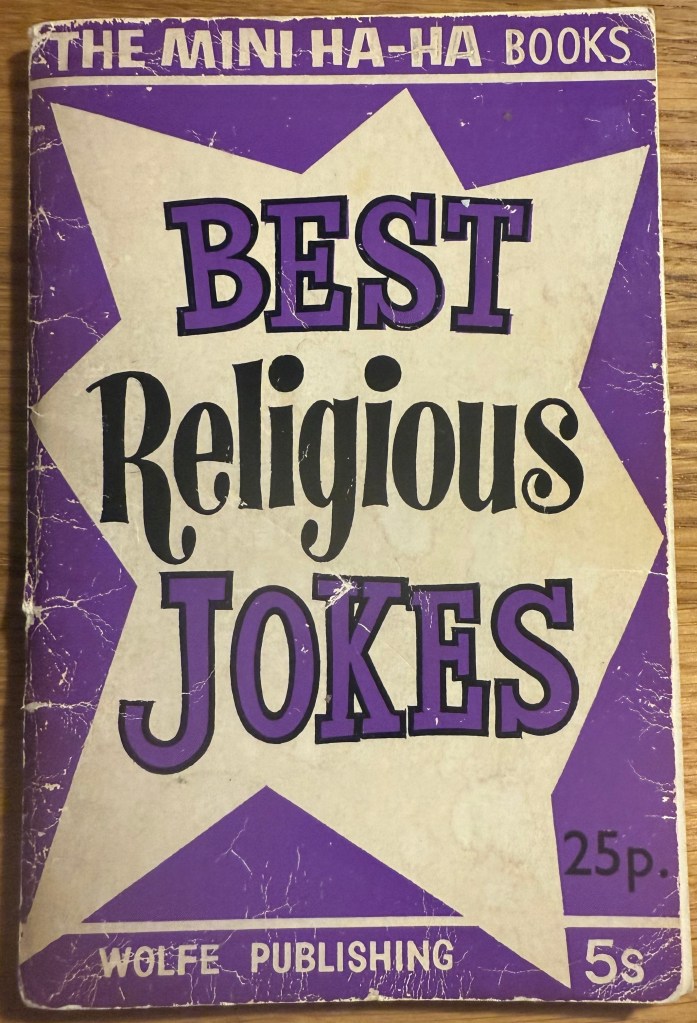
The other day my dad gave me a book that meant a lot to me in my childhood and teenaged years. It was a book I handled reverentially because within its pages there were many wise lessons for a well-lived life. The book was Best Religious Jokes and when I opened it up, I realised that forty years later some of this material is still in my repertoire. Here’s one:

In the Sunday school class the teacher was going through the Ten Commandments and had just explained “Honour thy father and thy mother.” The teacher then  made the mistake of asking the children if they could think of a commandment that teaches how to treat our brothers and sisters. Little Jenny thought for a moment and then answered, “Thou shalt not kill.”


The broadcaster and writer Garrison Keillor is the person who first springs to mind when I think of the word ‘humourist.’ I have been a fan of his for years and finally saw him live last year. He once said, “Humor is not a trick or a joke put into words. It’s a presence in the world, like grace, and it’s there for everyone.”

As many people have pointed out there is humour in the Bible. If Jesus was working in comedy now he wouldn’t be winning Perrier comedy awards but he did use humour to make his point. The one that immediately springs to mind is his illustrating a message about hypocrisy with these ludicrous images: “Don’t try to take the speck of dust out of your neighbour’s eye when you have a plank of wood in your own.” “It is easier for a camel to pass through the eyes of a needle than for a rich man to enter the kingdom of God.” Or how about, “Be one guard against false prophets, who come to you as wolves in sheep’s clothing?” It’s like a scene from a Looney Tunes cartoon, this image of the wolf putting on the sheep outfit.


Elsewhere in the Bible we have the writer of Ecclesiastes effectively lampooning a overly negative world view with verses like: “Everything is pointless. The river flows into the sea but the sea is never full.” Other religious traditions also do comedy. The rhythm of this Buddhist joke is a little off but it is a funny two-liner:Ling-ien was asked: ‘How were things before Buddha came into the world?’ Ling-ien whacked the questioner with a stick.

In my own case, humour has always been a way of making sense of the world. It can build bridges between people who are quite different, and sometimes taking ourselves a little less seriously makes us easier to live with. For example, one of the things from this year that is still making me smile is the fact that a few months ago I wrote an email to a student that was meant to read ‘I’d like to apologise in advance…’ but I was typing too quickly and not very carefully so when the student received it, the message read, “I’d like to apologise in a dance.” It seemed I’d invented a whole new genre of apology and both I and the student were amused. My mistake broke the ice very effectively.

So today I’m grateful for all the people and incidents in life this year that have made me laugh or smile and I leave you today with a line from Sam Sanders:

If you feel the weight of the world on your shoulders, remember:

That’s not how gravity works.

Day 17: ‘Not so different’ by Helen Pollard

When on holiday recently I visited the Golden Temple at Amritsar.  It is the spiritual home of the Sikhs.

I knew nothing about the religion apart from that the men with their turbans and beards looked very different to followers of the Christian faith.  Subsequently I assumed that their religion would be too.  If I had to guess I would have said that it was an offshoot of Hinduism with it’s god’s and myths.

At the temple there is a museum so I decided to gain some understanding of this mystical religion.  Imagine my surprise when I found out that their philosophy is simple:

One God 
A single formless God who created everything and is present in all creation

Equality and Unity
All people are equal regardless of colour, social status or religion

Truthful Living
Living honestly, working hard and helping others.

On reading these tenets, I was struck by how they are  also the basic message of the three great religions of Christianity, Islam and Judaism. 

So despite seeming different, the Sikhs are not so very different to us. 

 Essentially they believe in God and  humanity.

Day 16: Christmas cards

In today’s blog, Alison reflects on Christmas cards, but ahead of that here are some interesting Christmas card interesting facts:

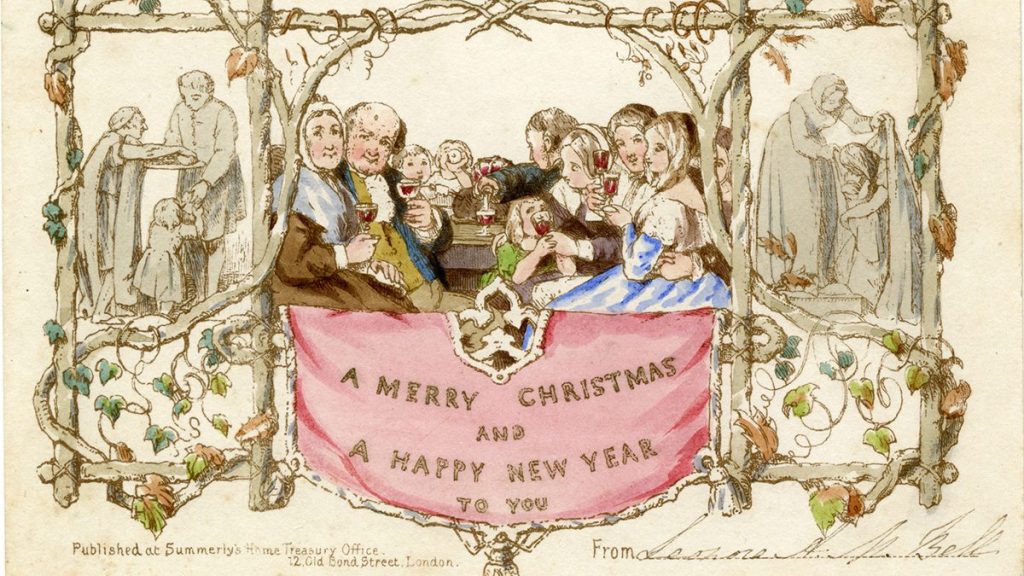
The first commercially produced Christmas card was produced by J.C Horsley in 1843 (see image below). One of these was auctioned in 2001 and sold for £22,260 (presumably it didn’t then get lost in the post).

Like so many Christmas traditions, the Christmas card took off in the Victorian era, aided by increasingly cheap printing methods and the introduction of the penny post (previously postage had been expensive and the recipient usually bore the cost).


The smallest ever Christmas card was created in 2017 but no image exists of it for the reasons outlined below (from the Guiness World Records website):


In December 2017, the National Physical Laboratory in Teddington, UK, used a beam of ions (positively charged atomic particles) to etch a Christmas card only 15 x 20 micrometres (0.0006 x 0.0009 inches) in size. Using a substrate of platinum-coated silicon nitride, the card is a true folded 3D shape, with the Christmas greetings message etched on the inner side of the card. The greetings card is so small that when an electron microscope was used to “photograph” the card, it pinged off the stand and was lost somewhere within the microscope itself.


The above Christmas cards are remarkable but today Alison shares some thoughts on what is remarkable in every Christmas card.

Christmas card connections (by Alison Thursfield)

December again, and the Annual Review of Christmas cards. I have a record of cards both sent and received each year since 1994 and it makes interesting reading. Nowadays the numbers sent and received are different as one loses touch with some people while new names are added, but this is a chance to think of friends and family who are no longer with us. 

Thinking back, I recall memories of people and events, from the big occasions to the very small; of plans made and problems shared; of laughter and camaraderie.  All come from the friendship and experiences shared over the years.

I am glad to be able to look back and enjoy my memories and I feel very blessed, not just at Christmas while writing cards, but all through the year. My list may change over time but for that I am grateful, as making new friends who I hope will become “old” friends is one of the pleasures of life. 

Now back to writing Cards!